Mouse Pad Black Cats: Designing a Workspace That Supports Your Daily Workflow
Your desk is more than a surface. It is the stage where decisions get made, projects move forward, and hours of focused effort turn into tangible results. Every item sitting on that desk either contributes to or detracts from your ability to work effectively. The Mouse Pad Black Cats design addresses both sides of that equation: it provides the functional surface your mouse needs while introducing a visual element that makes the workspace feel intentional rather than accidental. This is not about decoration for its own sake. It is about building an environment that quietly reinforces the mindset you bring to your work.
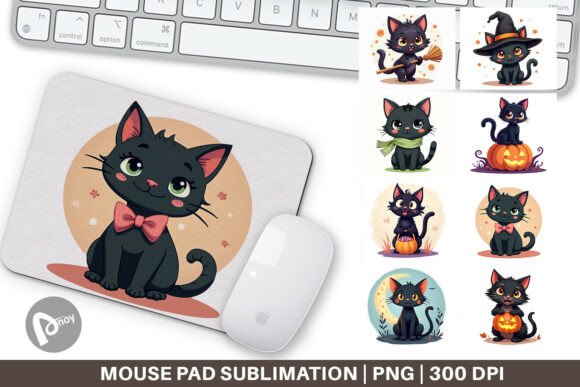
When you receive the PNG files for this sublimation mouse pad—8 files at 9.5 x 8.1 inches, 300 dpi—you are not just getting images. You are receiving ready-to-use assets that integrate into a broader production or personalization process. Whether you plan to press these onto blank sublimation pads yourself or send them to a print provider, the files represent a practical starting point. The dimensions are specific, the resolution is print-ready, and the design work is already done. What remains is the execution.
Where a High-Quality Mouse Pad Fits Into Your Broader Process
Think about the last time you reorganized your workspace. Maybe you upgraded your monitor, switched to a mechanical keyboard, or finally routed your cables so they do not snake across the desk in chaos. Each change was part of a larger intention: to make the space work better for you. A mouse pad often gets overlooked in this sequence. It is treated as an afterthought, something generic picked up at an office supply store. But the pad you use every day interacts with your mouse sensor, your wrist position, and your visual field. Ignoring it means leaving an easy improvement on the table.
The Mouse Pad Black Cats design fits into that workspace upgrade process as a deliberate choice. The black cat motif is not loud or distracting. It carries a quiet, focused energy that suits late-night coding sessions, early morning planning blocks, or the steady rhythm of iterative creative work. The sublimation printing method ensures the design bonds into the surface rather than sitting on top where it can peel, fade, or wear unevenly. For anyone who has dealt with mouse pads that start looking tired after three months, this distinction matters.
From a practical standpoint, the mouse pad becomes part of your daily workflow infrastructure. Your mouse glides across it hundreds of times per hour. Your wrist rests on its edge. Your eyes catch glimpses of it between tasks. When all of those micro-interactions are supported by quality materials and a design you actually like, the cumulative effect over weeks and months is real. It is one less source of low-grade friction in your workday.
Pre-Production Planning Before You Press or Print
Receiving the 8 PNG files is step one. Before you move to production, there are considerations that affect the final outcome. Sublimation requires a polyester or polymer-coated surface to accept the ink properly. Not every blank mouse pad works with sublimation, so confirming compatibility is essential. If you are sourcing blanks yourself, look for ones specifically labeled for dye-sublimation with a white or light-colored surface. Dark blanks will not show the design clearly because sublimation ink is translucent and relies on the white background for brightness.
The files are sized at 9.5 x 8.1 inches. Most standard mouse pad blanks fall within a similar range, but you should measure your specific blank against the file dimensions. Slight trimming may be needed, or you might adjust your pressing parameters to account for bleed. The 300 dpi resolution means the artwork holds up at full size without pixelation, which is critical for a product you will look at every day. Low-resolution prints break the illusion of quality quickly.
If you are sending the files to a third-party printer, check their file format and profile requirements. Most will want PNG or TIFF files in an sRGB color space. The black tones in the cat design need to print with enough depth to define the silhouette clearly, so avoid color profiles that muddy the shadows. A quick test print on paper at reduced size can reveal issues before you commit to the final substrate.
Integrating the Mouse Pad Into Your Desk Setup
Desk layout is personal and task-dependent. A graphic designer, a data analyst, and a writer all use their mouse differently. But certain principles apply across roles. The mouse pad should sit flush with the edge of the desk or slightly back, depending on your chair height and arm angle. Its surface should be large enough to accommodate your typical mouse movement range without forcing you to lift and reposition constantly. The 9.5 x 8.1 inch size works well for moderate sensitivity settings and standard work tasks. If you use very low DPI settings for precision work, you may need a larger pad, but for most professionals, this size strikes a functional balance between coverage and desk footprint.
Since the design features black cats, it pairs naturally with dark-themed desk setups, minimalist arrangements, or any workspace where you want a focal point that does not scream for attention. The sublimated surface also offers a consistent texture that optical and laser mouse sensors read accurately. Inconsistent or overly reflective surfaces cause cursor jitter, which disrupts tasks like selecting text, adjusting sliders in design software, or navigating spreadsheets. A reliable tracking surface removes that variable entirely.
Consider how the pad interacts with other tools on your desk. If you use a keyboard tray, the mouse pad may sit on the main desk surface nearby. If you use a large desk mat that spans under both keyboard and mouse, the black cat pad can layer on top for dedicated mouse space with a different texture or as a secondary work zone. Some people alternate between a stylus tablet and a mouse depending on the task; the pad provides a defined area for mouse work that keeps the tablet surface clear when not in use.
Workflow Benefits That Compound Over Time
Small improvements do not revolutionize your productivity overnight. They accumulate. A mouse pad that looks good and performs well removes tiny daily annoyances: the cursor skipping, the edge curling up, the design fading into something you actively dislike looking at. Each annoyance seems trivial in isolation. However, multiply them across hundreds of workdays and the cognitive tax becomes measurable. You might not notice it leaving, but you will notice that your workspace feels slightly more composed, slightly less draining.
The Mouse Pad Black Cats sublimation pad also introduces a anchoring element. When your workspace reflects something you chose deliberately rather than accepted by default, it shifts how you relate to the space. You are more likely to keep the desk tidy. You are more likely to sit down with intention. These psychological levers are subtle, but they matter for knowledge workers, freelancers, and anyone whose output depends on sustained mental engagement. The mouse pad is a tactile and visual cue that says: this space is set up for work that matters.
For those who work from home, the line between personal and professional can blur. Having dedicated work objects—a distinctive mouse, a specific notebook, a particular mouse pad—helps create that boundary. The black cat design can serve as one of those artifacts. When you see it, you are in work mode. When you step away, it remains there waiting, not as a generic corporate logo pad but as something you actually chose.
Using the PNG Files for Multiple Purposes
While the primary intent is creating a sublimation mouse pad, the 8 PNG files at 300 dpi have flexibility. The same designs can appear on other sublimation blanks: coasters, small fabric prints, phone case inserts, or custom notebook covers. The black cat imagery works across these formats because it is graphic and scalable. You might produce a matching set: a mouse pad for the desk, a coaster for your coffee, a small print pinned to the wall nearby. Visual consistency across work tools reinforces the intentional design of your environment.
For small business owners, these files offer a straightforward product line addition. Sublimated mouse pads are popular in niche markets, and cat-themed designs appeal to a sizable audience. The files arrive ready to press, so production time is minimal once you have your blanks and equipment. For creators selling at markets or through online shops, the ability to offer a cohesive product set without commissioning original artwork for each item streamlines the process considerably.
Educators and content creators can also use these files in tutorials or demonstrations. Showing the sublimation process from file to finished product is valuable content for YouTube channels, blog posts, or workshop materials. The black cat design gives you a visually compelling subject that holds attention better than a generic test pattern. The 300 dpi resolution and specific dimensions give you reliable specifications to reference when explaining file preparation, color management, and pressing techniques.
Quality Control and Consistency Checks
Whether you produce one mouse pad for yourself or a batch for customers, consistency matters. Check that your heat press maintains even temperature across the entire platen. Cold spots cause uneven transfer, which shows as faded areas or color shifts on the finished product. Use butcher paper or a protective sheet between the platen and the sublimation paper to prevent ghosting or ink transfer to your equipment. Pressing time and temperature vary by blank and ink manufacturer, so run a single test before committing to a full run.
Inspect the finished pad under good lighting. The blacks should be deep, the lines crisp, and the surface free of blemishes. Run your mouse across it to confirm smooth tracking. Check the edges: if the pad has stitched edging, ensure the stitching is straight and secure. If it is a die-cut pad with raw edges, confirm there is no fraying or delamination. These quality checks mirror what you would do for any product that sits on a desk and sees daily use.
Store finished pads flat rather than rolled to prevent curling. If you ship them to customers, use rigid mailers with cardboard backing to protect the shape during transit. A curled mouse pad frustrates the end user and undermines the perceived quality of an otherwise well-made product. Small protective steps during packaging preserve the effort you invested in production.
Maintaining the Sublimated Surface Over Time
Sublimated designs are durable because the ink becomes part of the material rather than a layer on top. Yet the surface still benefits from occasional cleaning. Dust, skin oils, and minor debris accumulate with use. A quick wipe with a damp microfiber cloth every week or two keeps the tracking surface consistent and the design looking fresh. Avoid harsh chemical cleaners that might degrade the fabric or affect the bonding between the printed layer and the base material. Mild soap and water are sufficient for most cleaning needs.
Rotate the pad or adjust its position periodically if you notice wear patterns developing in the most used areas. This is more relevant for fabric-topped pads than hard surfaces, but it applies broadly. Even a sublimated pad can show faint signs of repeated friction in the primary mouse zone over years of heavy use. Extending that lifespan comes down to simple habits: clean hands, a clean desk, and storing the pad properly if you ever need to move it.
For gamers who use the pad in high-intensity sessions, the durability differences between sublimated prints and screen-printed alternatives become apparent quickly. Screen printing can wear thin, crack, or flake under heavy mouse movement. Sublimation avoids these failure modes entirely. The image is not a coating; it is integrated. That engineering advantage means your black cat design stays intact through thousands of hours of use.
Making the Decision to Upgrade Your Desk Setup
Choosing a mouse pad might seem minor compared to buying software, upgrading hardware, or restructuring how you manage projects. But the theme here is integration. Your workspace is a system, and every component either strengthens or weakens the whole. A Mouse Pad Black Cats sublimation pad strengthens it. The functional needs of mouse tracking, wrist comfort, and surface durability are met. The aesthetic need for a workspace that feels like yours is met. The practical need for an item that lasts is met.
For professionals who spend eight or more hours a day at a computer, these micro-decisions about the physical environment are worth making intentionally. You already invest in ergonomic chairs, proper lighting, and tools that support your workflow. The mouse pad sits in the middle of that ecosystem, both literally and figuratively. The PNG files give you flexibility in how you bring the design to life—DIY pressing, working with a printer, or even printing the artwork for other uses. That flexibility fits the reality of modern work, where people blend maker skills with professional tasks and value having options.
The black cat design itself resonates with people who prefer a workspace that feels grounded and slightly subdued. It does not compete for attention with your code, your designs, your spreadsheets, or your writing. It sits there, present but not intrusive, until you glance down and remember that your workspace looks exactly how you want it to look. That moment of recognition—seeing your own choices reflected back at you throughout the day—is the culmination of a process that starts with a well-prepared PNG file and ends with a more intentional desk.